













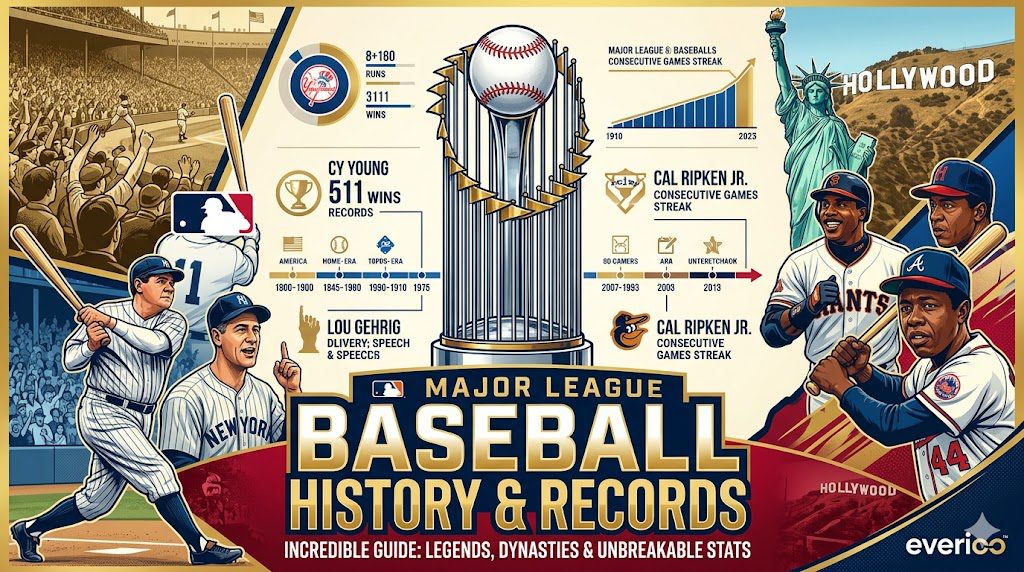
Major League Baseball History and Records: Incredible Encyclopedia of Legends & Stats
The Eternal Heritage of America’s Pastime
To truly comprehend the structural DNA of sports culture in the West, one must immerse themselves completely in the deep statistical archives of Major League Baseball History and Records. For over a century and a half, baseball has served as the definitive lens through which generations of fans have witnessed the evolution of professional sports. Unlike modern high-paced games that rely heavily on a ticking clock, baseball is a game of infinite space and tactical patience. It is an intense, pitch-by-pitch battle of wits where fractions of a second determine the fine line between an unforgettable home run and a heartbreaking strikeout.
For international sports observers in countries like India, where cricket commands supreme loyalty, exploring Major League Baseball History and Records offers a fascinatingly familiar yet entirely distinct universe of strategic execution. The sport shares structural roots with cricket, utilizing bats, balls, innings, and complex fielding setups, yet its professional postseason and statistical metrics are entirely unique.
The archives of Major League Baseball (MLB) function as a prestigious sports museum, charting the journey of legendary franchises through intense periods of societal change, technological advancement, and analytical revolutions. From the dead-ball eras of the early 1900s to the modern data-driven space of advanced sabermetrics, this sport has provided some of the most unbreakable milestones in human history. In this premier, expanded encyclopedia, the analytical sports desk at everioo delivers an exhaustive breakdown of the historical eras, legendary team dynasties, individual statistical peaks, and structural rules that define the legendary universe of Major League Baseball History and Records.

1. The Historical Evolution of MLB Eras
The vast timeline of Major League Baseball History and Records is traditionally divided into several distinct, fascinating eras. Each era was defined by unique equipment standards, playing styles, and tactical philosophies that directly impacted how statistics were recorded.
The Dead-Ball Era (1900–1919)
During the infancy of the unified American and National Leagues, the sport was played under conditions that heavily favored defensive units and pitchers:
-
The baseball itself was constructed with a soft core and was often used continuously throughout an entire game, causing it to become soft, dark, and incredibly difficult for batters to see or hit cleanly.
-
Managers relied on “small ball” tactics—such as sacrifice bunts, aggressive base stealing, and hit-and-run plays—to scratch out single runs.
-
This era produced legendary pitchers like Cy Young and Walter Johnson, whose pitching milestones remain firmly locked at the top of Major League Baseball History and Records due to the sheer volume of complete games they threw.
The Live-Ball Era and the Power Revolution (1920–1941)
The landscape of the sport changed overnight in 1920 due to two structural shifts: the introduction of a brand-new, tightly wound, highly responsive baseball, and the sudden rise of a young superstar named Babe Ruth.
-
Babe Ruth single-handedly transformed baseball from a game of directional bunts into a spectacle of explosive power hitting.
-
His revolutionary upward swing proved that hitting home runs was a highly efficient offensive strategy, launching a golden era of high-scoring games and permanently rewriting the offensive books within Major League Baseball History and Records.
The Integration and Expansion Era (1947–1968)
On April 15, 1947, Jackie Robinson stepped onto Ebbets Field for the Brooklyn Dodgers, shattering the sport’s color barrier and changing Major League Baseball History and Records forever. The integration of exceptionally talented Black and Latino ballplayers raised the overall standard of athletic competition to unprecedented heights. This era also witnessed geographic expansion, as historic franchises migrated to western cities like Los Angeles and San Francisco, turning MLB into a truly coast-to-coast national enterprise.
2. Understanding the Complex Playing Structures and Core Rules
For those tracking the statistical benchmarks within Major League Baseball History and Records, having a flawless understanding of the game’s structural mechanics is absolutely mandatory.
The Nine-Inning Battle of Attrition
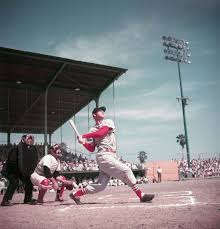
A standard Major League Baseball game is played over nine distinct segments known as innings, with no time limit. Each inning is split into two halves: the top half (where the visiting team bats) and the bottom half (where the home team bats).
-
The defensive team fields nine players on a diamond-shaped field, anchored by the pitcher and the catcher.
-
The offensive team sends individual batters to the home plate to face the pitcher.
-
The primary objective of the defensive unit is to record three “outs” through strikeouts, flyouts, or tagouts, which instantly ends the half-inning and allows the teams to switch roles.

Major League Baseball History and Records
The Scoring Mechanics: Runs, Hits, and Errors
Every single official box score in baseball history is anchored by three primary metrics: Runs (R), Hits (H), and Errors (E).
| Scoring Metric | Structural Definition | Impact on Postseason Records |
| Run (R) | Awarded when an offensive player successfully touches all four bases in order. | The ultimate metric that determines wins and losses in Major League Baseball History and Records. |
| Hit (H) | Occurs when a batter hits the ball cleanly into fair territory and reaches base safely without a defensive mistake. | Essential for building a player’s lifetime batting average (BA) milestones. |
| Error (E) | Recorded when a defensive fielder fails to convert a routine play due to a physical or mental slip. | Crucial for tracking defensive efficiency and unearned run statistics. |
3. The Greatest Team Dynasties in Major League Baseball History
When analyzing team achievements within Major League Baseball History and Records, certain elite franchises have managed to build multi-decade empires of absolute postseason dominance.
The New York Yankees: The Ultimate Championship Standard
No discussion regarding Major League Baseball History and Records can begin without acknowledging the New York Yankees. Carrying an unbelievable 27 World Series Championships, the Yankees are the most successful franchise in North American professional sports history.
-
Their historical timeline features legendary powerhouse rosters, most notably the 1927 “Murderers’ Row” lineup which featured Babe Ruth and Lou Gehrig.
-
In the late 1990s, the Yankees established another historic dynasty under manager Joe Torre, powered by the “Core Four” (Derek Jeter, Mariano Rivera, Andy Pettitte, and Jorge Posada), capturing four World Series titles in a span of five years.
The St. Louis Cardinals: The Powerhouse of the National League
Sitting comfortably behind the Yankees with 11 World Series Titles, the St. Louis Cardinals represent the absolute standard of excellence within the National League. From the roaring “Gashouse Gang” rosters of the 1930s to the legendary hitting prowess of Albert Pujols in the 2000s, the Cardinals have maintained a culture of consistent player development and passionate fan support that shines brightly across Major League Baseball History and Records.
The Boston Red Sox: From the Curse to Modern Dominance
The Boston Red Sox hold a uniquely dramatic position within Major League Baseball History and Records. After trading Babe Ruth to the Yankees in 1919, the franchise suffered an infamous 86-year championship drought known across pop culture as the “Curse of the Bambino.”
-
The drought was shattered in historic fashion in 2004 when the Red Sox became the first team in MLB history to overcome a 3-0 postseason series deficit against the Yankees.
-
They went on to win the World Series that year, launching a highly successful modern era that secured four championships in the 21st century.
4. Unbreakable Individual Records: Milestones That Will Never Fall
The individual ledger of Major League Baseball History and Records contains statistical peaks achieved under extreme physical duress that modern analysts believe are completely safe from future generations due to structural shifts in how the modern game is managed.
Cy Young’s 511 Career Pitching Victories
At the absolute peak of unbreakable sports milestones stands Cy Young’s mind-boggling record of 511 career wins. During the early turn of the century, starting pitchers routinely threw over 400 innings per season and were expected to finish every single game they started. In the modern era of baseball, tightly regulated pitch counts, specialized middle-relief pitchers, and closer strategies mean that a modern star pitcher rarely starts more than 33 games a year. For a contemporary pitcher to match Cy Young, they would have to win 25 games a season consecutively for over 20 years, a feat that is physically impossible in the modern sports landscape.
Cal Ripken Jr.’s 2,632 Consecutive Games Played
Known universally as baseball’s “Iron Man,” Baltimore Orioles shortstop Cal Ripken Jr. achieved a legendary milestone by playing in 2,632 consecutive games over a span of 16 years without missing a single day due to injury, exhaustion, or poor form. In an era dominated by sports science, load management, and mandatory rest cycles, no modern athlete comes anywhere near this baseline, securing Ripken’s permanent, legendary status within Major League Baseball History and Records.
The Legendary Home Run Milestones
The chase for the home run crown has provided the most electrifying media moments in American sports history:
-
Hank Aaron: For decades, Hank Aaron stood as the ultimate home run king, hitting 755 career home runs while overcoming immense racial hostility, symbolizing absolute structural consistency.
-
Barry Bonds: Holds the single-season home run record with an explosive 73 home runs hit in 2001, along with the all-time career record of 762 home runs, milestones that continue to dominate historical sports debates worldwide.
5. The Modern Sabermetric Revolution: Data Over Intuition
In the late 1990s and early 2000s, an absolute intellectual revolution swept through the front offices of professional baseball, fundamentally altering how talent is evaluated within Major League Baseball History and Records. This movement, famously chronicled in the book and film Moneyball, is known as sabermetrics.
The Devaluation of Traditional Statistics
For over a century, scouts evaluated batters based almost exclusively on their Batting Average (BA) and Runs Batted In (RBIs). Sabermetric pioneers proved that these metrics were deeply flawed and dependent on outside team factors. Instead, advanced analytics placed a massive premium on On-Base Percentage (OBP)—which measures a batter’s absolute ability to avoid making an out by any means necessary, including base hits and walks.
The Rise of WAR (Wins Above Replacement)
The definitive modern metric that completely dominates contemporary discussions of Major League Baseball History and Records is Wins Above Replacement (WAR). WAR is a highly complex, comprehensive stat that distills a player’s total contribution—including hitting, base running, and defensive fielding precision—into a single mathematical number. Major League Baseball History and Records This figure shows exactly how many additional wins a player provides to their franchise compared to a standard, readily available minor-league replacement player. This analytical shift has allowed modern front offices to discover massive amounts of hidden value in undervalued players across the globe.
6. The Anatomy of a Roster: Balancing Youth and Analytics
Building a championship roster capable of etching its name into the grand book of Major League Baseball History and Records requires immense financial discipline, structural scouting networks, and state-of-the-art player development systems. Roster architects typically structure their organizations around three foundational pillars:
-
The Dominant Starting Rotation: Postseason baseball is heavily driven by elite pitching. Having a group of three to four elite starting pitchers who can command multiple pitch types (fastballs, sliders, changeups) forms the bedrock of defensive stability.
-
The High-Value Bullpen: As games progress into the high-pressure late innings, managers rely heavily on specialized relief pitchers who throw high-velocity pitches to shut down opposing hitters in short bursts.
-
The High-OBP Attacking Core: Modern tracking data shows that avoiding empty outs is the most predictable path to scoring runs. Teams focus heavily on acquiring batters with exceptional strike-zone discipline who can tire out opposing pitchers over long at-bats.
7. Exclusive everioo Tactical Verdict: An Enduring Legacy
At everioo, our global sports desk continuously monitors the cultural footprint of international sports leagues. When tracking the global reach of Major League Baseball History and Records, our structural verdict is clear: The historical value of baseball analytics is more influential today than ever before.
The sophisticated analytical methods developed within Major League Baseball have served as the exact blueprint for modern Major League Baseball History and Records tracking systems across international sports, including the data-heavy structures seen in the Indian Premier League (IPL) and European soccer. By merging rich historical traditions, legendary individual rivalries, and bleeding-edge tracking technology, Major League Baseball maintains an iron-clad grip on the global sporting imagination, offering sports enthusiasts an unmatched, intellectually stimulating journey through sports history.
8. Frequently Asked Questions (FAQs) on MLB History and Records
Q1. Who holds the record for the highest career batting average in MLB history?
The legendary Ty Cobb holds the absolute record for the highest career batting average in Major League Baseball History and Records, finishing his historic career with an astonishing .366 lifetime average over 24 thrilling seasons.
Q2. What is the difference between the American League (AL) and the National League (NL)?
Historically, the primary difference was the Designated Hitter (DH) rule, which allowed American League teams to use a specialized hitter to bat in place of the pitcher. However, the rule was unified across both leagues recently, creating structural harmony across the entire sport.
Q3. Why are Cy Young’s pitching records considered completely unbreakable?
Cy Young played during the dead-ball era when pitchers routinely threw over 400 innings per season and completed almost every game they started. Modern sports science, strict pitch counts, and specialized relief strategies mean no contemporary pitcher will ever match his volume of game time.
Q4. How did the Moneyball revolution change Major League Baseball?
The Moneyball sabermetric revolution shifted the focus of talent evaluation away from traditional, subjective scouting metrics like raw batting average toward data-driven, objective statistics like On-Base Percentage (OBP) and Wins Above Replacement (WAR), allowing low-budget teams to compete against wealthy franchises.
Q5. Which team has won the most World Series championships in history?
The New York Yankees hold the absolute record within Major League Baseball History and Records, capturing an unparalleled 27 World Series titles across their franchise history.