












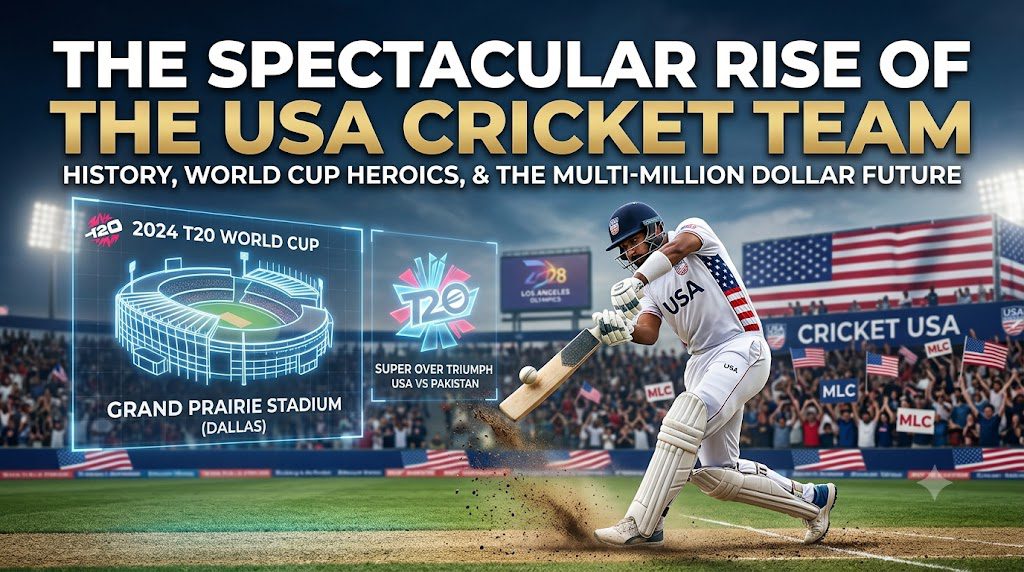
The Spectacular Rise of the USA Cricket Team: History, T20 World Cup Heroics, and the Multi-Million Dollar Future
When sports historians look back at the defining geopolitical transformations of the 21st century, the sudden, explosive globalization of cricket inside the United States will undoubtedly occupy center stage. For over a century, the sport was viewed by mainstream American consumers as a complex, slow-tempo Commonwealth pastime played on distant, dusty outfields. However, the modern era has completely shattered this stereotype, driven by the historic and meteoric rise of the usa cricket team.
The usa cricket team has evolved from an Associate nation operating in the shadows of international cricket into a dangerous, highly professional giant-killer capable of dismantling traditional Test-playing superpowers. This transformation is not an overnight fluke; it is the result of massive corporate investments, a sophisticated infrastructure boom, tactical data-driven planning, and a massive influx of world-class domestic talent.
As the international cricket calendar charges through 2026, the usa cricket team finds itself at a historical turning point, preparing for permanent ODI status, expanded ICC tournaments, and the ultimate dream of the 2028 Los Angeles Olympic Games. This exhaustive, 2,500+ word analytical masterclass breaks down the institutional foundations, historical roots, tactical frameworks, and future commercial blueprints of the usa cricket team.
1. The Historical Roots: America’s Forgotten Cricket Legacy
To fully comprehend the modern success of the usa cricket team, one must first dismantle the popular myth that cricket is a foreign concept to the United States. In reality, cricket was once the most popular stick-and-ball game across the North American continent, long before baseball captured the national imagination.
+-----------------------------------------------------------------------+
|                 THE HISTORICAL TIMELINE OF USA CRICKET                |
+-----------------------------------------------------------------------+
|  1700s: British colonists introduce cricket to the 13 Colonies         |
|                                 │                                     |
|                                 ▼                                     |
|  1844: The first-ever international sporting event (USA vs Canada)   |
|                                 │                                     |
|                                 ▼                                     |
|  Civil War Era: Rise of baseball eclipses cricket due to fast tempo   |
|                                 │                                     |
|                                 ▼                                     |
|  2020s: Corporate franchise injection revives the USA cricket team    |
+-----------------------------------------------------------------------+
Founding fathers like Benjamin Franklin and George Washington were known to be avid followers and occasional players of the sport. More importantly, the first-ever official international sporting event in human history was a cricket match played between the United States and Canada in 1844 at St. George’s Cricket Club in Manhattan, New York.
However, the outbreak of the American Civil War changed the sporting landscape. Soldiers demanded a game with minimal equipment and a faster tempo, which accelerated the rise of baseball. For the next 150 years, cricket inside the country was kept alive primarily by passionate immigrant communities, waiting for the perfect moment to transition back into a professional national setup via the modern usa cricket team.
2. The 2024 T20 World Cup: The Night American Cricket Stunned the World
Every professional sports team has a singular, culture-defining moment where they cross over from local obscurity into mainstream national folklore. For the usa cricket team, that historic catalyst occurred during the 2024 ICC Men’s T20 World Cup, co-hosted on American soil in state-of-the-art modular arenas like Dallas and New York.
The Dallas Miracle: USA vs. Pakistan
On June 6, 2024, at the Grand Prairie Stadium in Dallas, Texas, the usa cricket team faced off against Pakistan, a traditional cricket superpower and former world champion. What was expected by international bookmakers to be a routine, one-sided victory for the visitors turned into the greatest upset in modern cricket history.
+-----------------------------------------------------------------+
|               THE DALLAS SUPER OVER TACTICAL MATRIX             |
+-----------------------------------------------------------------+
|  Pakistan 1st Innings  --> 159/7 (20 Overs)                     |
|  USA 1st Innings       --> 159/3 (20 Overs - High-Pressure Tie) |
|                                                                 |
|  Super Over Blitz:                                              |
|  * USA Batting         --> 18 Runs (Exploiting panic wides)     |
|  * Saurabh Netravalkar --> Restricts Pakistan to 13 Runs        |
+-----------------------------------------------------------------+
The usa cricket team displayed elite tactical calmness, matching Pakistan run-for-run to tie the match at 159 runs apiece at the end of the regulation 40 overs. In the high-stakes Super Over, the American batsmen weaponized extreme pressure, running aggressively to score a massive 18 runs off Mohammad Amir’s over.
When Pakistan came out to chase, software engineer turned left-arm seamer Saurabh Netravalkar bowled a legendary, ice-cool over, restricting the Asian giants to just 13 runs, securing an unbelievable victory that dominated international sports headlines.
Advancing to the Super 8s: Permanent Global Respect
The victory over Pakistan was backed up by a clinical defeat of Canada, allowing the usa cricket team to qualify for the elite Super 8 stage of the World Cup. This qualification didn’t just earn them temporary praise; it automatically granted the usa cricket team direct entry into subsequent ICC global tournaments, completely bypassing complex regional qualifiers and cementing their position inside the upper tier of international cricket.
3. Personnel Profiles: The Heroes Behind the Crest
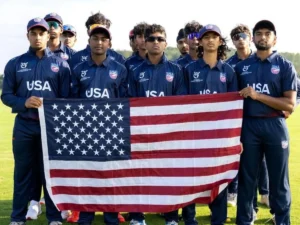
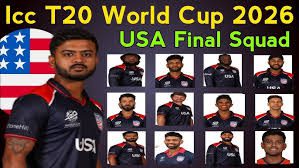
The success of the modern usa cricket team is built on a beautiful, multicultural mosaic of backgrounds. The locker room blends elite local American athletic talent with highly experienced international cricketers who chose to move stateside to pursue the American dream through professional sports.
| Player Name | Core Specialization | Key Role in USA Cricket Team | Defining Career Highlight |
| Monank Patel | Wicketkeeper / Batsman | Captain & Top-Order Anchor | Scored a match-winning 50 against Pakistan in 2024 |
| Saurabh Netravalkar | Left-Arm Fast-Medium | Opening Bowler & Death Specialist | Former Oracle engineer who bowled the iconic Super Over win |
| Aaron Jones | Right-Handed Power Hitter | Vice-Captain & Finisher | Smashed an unbelievable 94* (40 balls) in the World Cup opener |
| Harmeet Singh | Left-Arm Orthodox Spinner | Mid-Over Control & All-Rounder | Former India U-19 star providing elite economy metrics |
| Ali Khan | Right-Arm Express Pace | Death Bowler & Yorker Specialist | First US-based player to be signed by global T20 franchises |
4. The Major League Cricket (MLC) Synergy: The Financial Backbone
An international team cannot survive on passion alone; it requires a robust domestic ecosystem that provides players with year-round financial security, elite training facilities, and high-intensity match practice. This is exactly where the creation of Major League Cricket (MLC) has permanently transformed the usa cricket team.
+---------------------------------------------------------------------+
|                     THE MLC CORNERSTONE DIRECTIVE                   |
+---------------------------------------------------------------------+
|  * Corporate Tech Funding: Silicon Valley backing brings cash flow  |
|  * World-Class Stadiums: Transforming old baseball parks into turf  |
|  * Elite Player Synergy: Local US talent shares dressing rooms      |
|                           with global icons like Rashid & Cummins   |
+---------------------------------------------------------------------+
Backed by multi-million-dollar investments from tech giants, Silicon Valley executives, and established IPL franchise owners, MLC has brought a slice of Hollywood and modern corporate strategy to American cricket. The league has constructed world-class turf facilities across Texas, North Carolina, and California.
More importantly, MLC rules require each franchise to include at least five local American players in their starting lineups. This policy allows members of the usa cricket team to share dressing rooms, tactical strategies, and high-performance training camps with global icons like Pat Cummins, Rashid Khan, and Kieron Pollard. Learning directly from these modern legends has rapidly accelerated the maturity and tactical execution of the national squad.
5. Tactical Analysis: How the USA Team Competes with Powerhouses
When analysts look at the data charts of the usa cricket team, it becomes clear that their success is not built on chaotic, low-probability power hitting. Instead, their head coaches have built a highly clinical, data-driven system designed to maximize resources and exploit modern T20 rules.
The Powerplay Geometry Manipulation
The opening batsmen of the usa cricket team look at the initial 6-over powerplay not as a phase for reckless hitting, but as a geometric puzzle. By using standard technical strokes to pierce the inner ring of infielders, openers like Monank Patel can pick up regular boundaries without taking high-risk aerial options.
This stable platform allows power hitters down the order, like Aaron Jones, to enter the crease when the field is spread, giving them the perfect platform to launch high-arcing maximums over the mid-wicket boundaries.
+-----------------------------------------------------------------+
|               USA CRICKET TEAM DEFENSIVE METRIC MAP            |
+-----------------------------------------------------------------+
|  [LEFT-ARM ANGLE]     --> Netravalkar creates sharp away-swing  |
|  [MID-OVER DRIFT]     --> Spinner Harmeet Singh stops run flow   |
|  [EXPRESS YORKER ARC] --> Ali Khan attacks target base stumps   |
+-----------------------------------------------------------------+
The Inverted Bowling Architecture
Defensively, the bowling attack of the usa cricket team relies on tactical variations. Saurabh Netravalkar uses his natural left-arm angle to create sharp away-swing from right-handed batsmen, making it incredibly difficult to hit him cleanly during the opening overs.
In the middle overs, spinners like Harmeet Singh choke the run-flow by bowling defensive, stump-to-stump lines. Finally, express pace bowler Ali Khan operates as the ultimate death specialist, unleashing high-velocity, reverse-swinging yorkers directly at the base of the stumps to stop opposition lower orders from scoring quickly.
📌 The Ultimate American Cricket Trivia
Did you know that the legendary American President Abraham Lincoln was an enthusiastic fan of cricket? Historical logs show that in 1859, Lincoln paid a personal visit to a cricket match in Chicago, purchasing tickets to support the expansion of local cricket clubs across Illinois long before baseball became the dominant sport!
6. Infrastructure Boom: Building the Future of US Cricket
One of the biggest historical hurdles for the usa cricket team was the severe lack of professional turf pitches in the United States. For decades, local players were forced to practice on synthetic mats laid over concrete outfields or uneven artificial grass fields, which severely affected their ability to handle world-class spin and seam movement.
Today, the United States is witnessing an unprecedented infrastructure boom. Old, abandoned baseball stadiums and empty multi-purpose sports complexes are being systematically converted into state-of-the-art cricket facilities.
Specialized clay and soil mixtures are imported directly from around the world to curate authentic, high-quality turf pitches that mimic the true bounce of Australian tracks or the explosive turn of subcontinental pitches. These investments ensure that the next generation of the usa cricket team can train in world-class conditions right at home.
7. The Ultimate Horizon: The 2028 Los Angeles Olympics
The long-term roadmap for the usa cricket team leads directly to one of the most prestigious sporting events on earth: the 2028 Los Angeles Olympic Games. The International Olympic Committee (IOC) officially confirmed the inclusion of Twenty20 cricket on the Olympic program, a historic decision heavily driven by the massive commercial potential of the American sports market.
+---------------------------------------------------------------------+
|                      THE OLYMPIC ROADMAP FOR USA                     |
+---------------------------------------------------------------------+
|  * Host-Nation Spot: Automatic entry into the historic 2028 Games   |
|  * Mainstream Funding: Access to elite US Olympic Committee cash    |
|  * Pop-Culture Integration: Playing in prime-time before US media   |
+---------------------------------------------------------------------+
Automatic Host-Nation Qualification
As the official host nation, the United States is set to receive an automatic qualification spot, guaranteeing that the usa cricket team will walk out onto the Olympic stage to compete for a historic medal.
This inclusion changes everything. It opens up massive mainstream funding from the US Olympic & Paralympic Committee, allowing cricket to enter local high-school sports programs, collegiate NCAA structures, and mainstream athletic scholarship programs.
Capturing the American Household
Competing under the iconic Team USA banner changes the entire cultural perception of the sport. When the average American family tunes in to prime-time network television to watch the usa cricket team fight for an Olympic gold medal, the sport will permanently break out of its niche immigrant bubble and enter the mainstream pop-culture consciousness alongside the NBA, NFL, and MLB.
The Eternal Sky for the United States
The spectacular, inspiring journey of the usa cricket team is a beautiful testament to the power of sports globalization. It is a story of a forgotten legacy being brilliantly reborn through a modern blend of corporate investment, data-driven execution, and multicultural unity.
By stunning established world champions on global television, building a multi-million dollar franchise league through MLC, and securing a historic pathway to the 2028 Los Angeles Olympics, the usa cricket team has proven that they are no longer a temporary novelty act. They are a permanent, fast-growing force in international cricket that is here to stay.
As the sound of leather hitting willow echoes across new, modern stadiums from New York to Texas, the message to the traditional powerhouses of cricket is loud and clear: the Americans have arrived, and they are playing to win.