












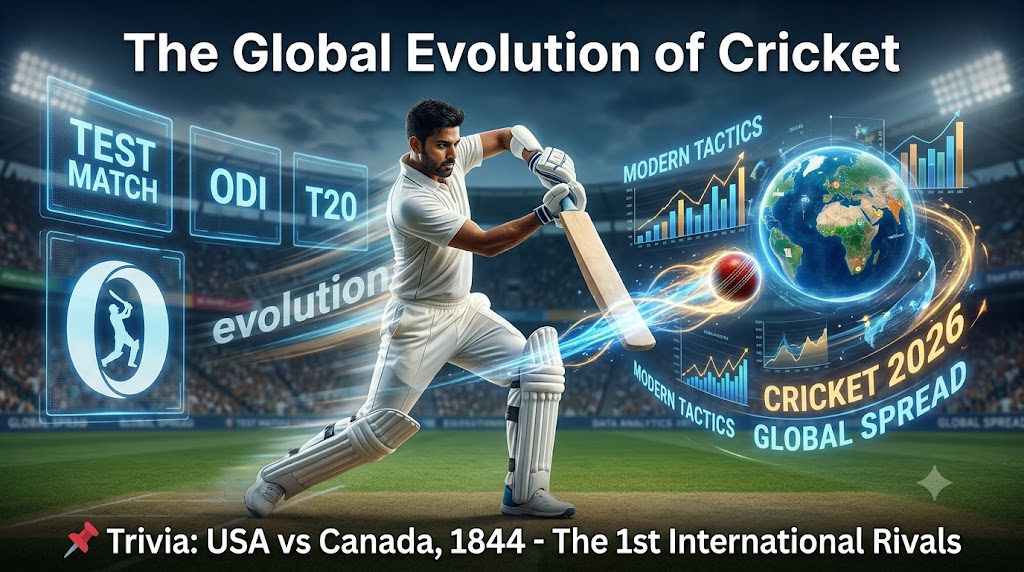
The Global Evolution of Cricket: History, Modern Tactics, and the 2026 Shift to New Horizons
In the vast ecosystem of international sports, few games capture the collective imagination of billions quite like cricket. What began centuries ago as a rustic pastime in the rural hamlets of southern England has evolved into a highly sophisticated, multi-billion-dollar global industry. Today, cricket is not merely a sport; it is an intricate blend of high-end sports science, complex data analytics, geopolitical soft power, and deep-rooted cultural folklore.
The game of cricket is defined by its unique capacity to adapt. It is a sport that can stretch across five grueling days in the pristine, traditional framework of Test matches, yet seamlessly shrink into a hyper-athletic, three-hour prime-time television spectacle via the Twenty20 (T20) format.
As the international calendar marches through 2026, the sport finds itself at yet another historic turning point. This exhaustive, 2,500+ word analytical masterclass breaks down the institutional foundations, technical mechanics, data-driven revolutions, and future structural expansions that define modern cricket.
1. The Historical Trajectory: How Cricket Conquered the World
To understand the modern geopolitical landscape of cricket, one must first look at its historical roots. The structural spread of the game is intimately tied to the history of the British Empire. As colonial trade routes expanded across the Caribbean, the Indian subcontinent, Southern Africa, and Australasia, the local populations adopted, reshaped, and ultimately mastered the game.
+-----------------------------------------------------------------------+
|                    THE THREE-PHASE EVOLUTION OF CRICKET               |
+-----------------------------------------------------------------------+
|  Phase 1: The Timeless Era (Multi-day Test matches, purely defensive) |
|                                 │                                     |
|                                 ▼                                     |
|  Phase 2: The One Day Revolution (Colored clothing, white balls, 50-over) |
|                                 │                                     |
|                                 ▼                                     |
|  Phase 3: The Franchise T20 Boom (Data analytics, global club contracts)|
+-----------------------------------------------------------------------+
The establishment of the Marylebone Cricket Club (MCC) at Lord’s in 1787 provided the sport with its definitive “Laws.” For over a century, cricket was dominated by the rigid social hierarchies of “Amateurs” and “Professionals.”
However, the true globalization of the game accelerated in the late 20th century. The introduction of the One Day International (ODI) format in the 1971 season, followed by the groundbreaking 1983 World Cup, broke the Anglo-Australian monopoly, turning South Asia into the commercial and emotional powerhouse of the sport.
2. The Biomechanical Blueprint: The Technical Art Form
At its highest level, cricket is a demanding physical battle of micro-adjustments. The interaction between a bowler delivering a leather ball at 150 km/h and a batsman responding within a fraction of a second requires elite cognitive processing and perfect muscle synchronization.
The Physics of Elite Fast Bowling
Modern fast bowling is a punishing physical task that tests the limits of human anatomy. To generate extreme velocity, a bowler must perfectly execute a multi-phase movement chain:
-
The Approach Run: Building linear kinetic energy and rhythm.
-
The Gathering Phase: Transitioning horizontal speed into vertical lift.
-
The Plant & Release: Stopping the front foot solidly to transfer all energy up through the core, shoulder, and wrist, releasing the ball at maximum speed.
+-----------------------------------------------------------------+
|                  THE BOWLER'S BALLISTIC COATING                 |
+-----------------------------------------------------------------+
|  [OUTSWING]     --> Seam angled toward slip; smooth side forward|
|  [INSWING]      --> Seam angled toward leg; rough side forward |
|  [REVERSE SWING]--> Aerodynamic asymmetry activated at high speeds|
+-----------------------------------------------------------------+
Furthermore, bowlers must master the art of aerodynamics. By intentionally keeping one side of the ball highly polished while allowing the other side to deteriorate and become rough, they create aerodynamic asymmetry. At high velocities, this difference in surface texture causes the ball to swing through the air, completely disrupting the batsman’s visual tracking.
The Modern Evolution of Batting Mechanics
Traditional cricket coaching focused heavily on playing late, keeping the ball on the ground, and maintaining a perfectly straight bat. While those fundamentals remain crucial in Test match survival, the explosion of short-form leagues has forced a radical change in batting mechanics.
Modern batsmen look at the crease not as a stationary anchor point, but as a dynamic space to manipulate angles. The widespread adoption of cross-batted power shots—such as the switch-hit, the scoop, and the reverse-sweep—requires extraordinary wrist flexibility and extreme core stability.
Batsmen now intentionally clear their front leg out of the hitting arc, transforming their lower body into a solid hitting base to launch yorkers over the boundary ropes.
3. The Structural Formats: Balancing Tradition and Commercialization
No other global sport features three entirely distinct competitive formats operating simultaneously at the international level. Each format requires a unique tactical mindset, distinct physical conditioning, and tailored squad selection.
| Format Variant | Operational Duration | Core Tactical Objective | Target Consumer Base |
| Test Matches | 5 Days (90 Overs/Day) | Patient attrition, taking 20 wickets, psychological stamina | Traditional purists, long-form sports analysts |
| One Day Internationals | 1 Day (50 Overs/Side) | Structured building, middle-over strike rotation, balanced transition | General sports audiences, traditional broadcasters |
| Twenty20 (T20Is) | 3 Hours (20 Overs/Side) | High-velocity boundary hitting, defensive variations, instant action | Modern digital consumers, prime-time television networks |
The Revival of Test Match Identity
For years, critics predicted the slow death of five-day cricket under the financial pressure of T20 leagues. However, the modern era has seen a spectacular creative revival.
Teams have discarded defensive, slow-tempo batting strategies in favor of hyper-aggressive, high-scoring approaches. By scoring at unprecedented rates of over five runs per over in red-ball matches, modern teams ensure that games rarely end in boring draws, keeping Test cricket highly relevant, unpredictable, and thrilling for the modern digital viewer.
4. The Data Analytics Revolution: The Rise of “Smart Cricket”
In 2026, decisions on the cricket field are no longer made purely on gut instinct or traditional locker-room wisdom. The sport has fully embraced advanced data tracking and mathematical modeling, turning coaching staffs into data labs.
+-----------------------------------------------------------------+
|                    ADVANCED CRICKET DATA METRICS                |
+-----------------------------------------------------------------+
|  1. MATCHUP ANALYSIS     --> High-density history of bowler vs batter|
|  2. BALL Hitting Arcs   --> Tracking optimal launch angles for power |
|  3. EXPECTED RUNS (xR)   --> Probability of scoring based on field traps|
+-----------------------------------------------------------------+
Matchup Optimization and Pitch Mapping
Before a team steps onto the field, analysts generate comprehensive matchup profiles for every opposing player. For instance, if data shows an opening batsman struggles significantly against left-arm orthodox spin during the first six overs of a match, the captain will instantly alter their traditional bowling rotation to exploit that exact statistical weakness.
Pitch heatmapping software allows teams to analyze exactly how a surface changes across different times of day, giving captains precise information on when to activate spin options or deploy high-velocity short-ball strategies.
📌 The Ultimate Cricket Trivia
Did you know that the oldest international sporting rivalry in the world belongs to cricket? Long before the modern Olympic Games or FIFA World Cups, the United States and Canada faced each other in an official international match in 1844 at St George’s Cricket Club in New York!
5. The Corporate and Franchise Landscape: Club vs. Country
The financial center of gravity in modern cricket has shifted dramatically from international bilateral tours to privatized franchise leagues. The model pioneered by the Indian Premier League (IPL) has been replicated globally, leading to the creation of year-round club tournaments across Australia, the Caribbean, South Africa, the UAE, and the United States.
The Rise of Year-Round Club Contracts
This franchise explosion has triggered an intense structural debate regarding player availability. Elite cricketers are no longer solely dependent on central contracts from their national boards.
Instead, many high-profile stars are choosing to opt out of traditional national team commitments to operate as global T20 mercenaries, signing lucrative multi-league deals with corporate franchise owners who run sister teams across multiple continents. This shift is forcing global governing bodies to redesign the international playing calendar to avoid direct scheduling clashes with prime domestic windows.
6. Global Expansion: Breaking New Frontiers in 2026
The year 2026 represents a landmark period for the global expansion of cricket. The International Cricket Council (ICC) has pushed heavily to break the sport out of its traditional commonwealth boundaries, targeting massive, untapped commercial markets.
+---------------------------------------------------------------------+
|                     THE OLYMPIC ROADMAP FOR CRICKET                 |
+---------------------------------------------------------------------+
|  * Los Angeles Games Inclusion: Introducing T20 to mainstream USA  |
|  * Major League Cricket Growth: Building world-class stadiums stateside|
|  * Grassroot High-Schools: Developing domestic multi-cultural talent|
+---------------------------------------------------------------------+
The American Infrastructure Boom
With the steady rise of Major League Cricket (MLC) in the United States and the long-term strategic goal of the Los Angeles Olympic Games, cricket infrastructure is experiencing an unprecedented boom on American soil.
State-of-the-art turf pitches, modular broadcasting stadiums, and elite training academies are being developed in major economic hubs like Texas, California, and New York. This infrastructure investment is successfully drawing multi-cultural youth demographics to the sport, laying a rock-solid foundation for a future competitive generation outside the game’s traditional strongholds.
7. Sports Science: The High-Performance Athlete
The modern professional cricketer is an elite, highly tuned athlete whose physical preparation mirrors that of a top-tier European soccer player or an NFL quarterback. The days of casual fitness standards are long gone, replaced by rigorous, data-driven conditioning metrics.
High-Velocity Biomechanical Screening
To maximize career longevity and prevent devastating stress fractures in fast bowlers, teams utilize high-performance motion-capture laboratories. These special facilities track a bowler’s joint angles, spinal rotation, and foot-plant impact forces down to the millimeter.
If an analyst detects that a bowler’s shoulder alignment is deviating from their optimal path, sports scientists can instantly design customized corrective strength routines to adjust their technique, protecting their body from long-term injury.
Position-Specific Conditioning
Modern training camps discard generic team fitness routines in favor of position-specific training programs:
-
Explosive Power Lifters (Power Hitters): Focus heavily on rotational core strength, Olympic lifts, and high-velocity medicine ball throws to maximize clearance speed at the crease.
-
Agility and Reflex Workers (Wicketkeepers & Infielders): Put through grueling neuro-tracking light drills and high-intensity plyometric exercises to sharpen multi-directional explosive movement.