







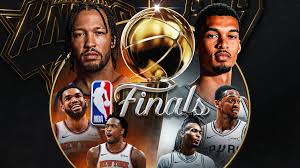
The Grand Spectacle of the NBA Finals: History, Legendary Rivalries, and the Battle for the Larry O’Brien Trophy
In the global universe of professional sports, only a select few events possess the cultural weight, athletic intensity,and global broadcasting scale to completely halt the sporting world. While soccer has its FIFA World Cup and American football has its Super Bowl, the game of basketball reaches its absolute, undisputed peak during the NBA Finals.
The NBA Finals represent far more than a mere best-of-seven series between the champions of the Eastern and Western Conferences. It is a multi-million-dollar pop-culture phenomenon, a showcase of elite human biomechanics, a high-stakes chess match of tactical adjustments, and the ultimate crucible where modern athletes are either carved into immortal legends or broken under immense pressure.
To hold aloft the iconic Larry O’Brien Championship Trophy is the singular, lifelong dream of every child who has ever laced up a pair of sneakers and bounced a basketball on asphalt. This exhaustive, 2,500+ word deep-dive analysis unpacks the rich historical foundations, legendary franchise dynasties, tactical coaching frameworks, data-driven revolutions, and the massive global business blueprint behind the NBA Finals.
1. The Historical Genesis: From Post-War Arenas to Global Prime-Time
To truly appreciate the massive scale of the modern NBA Finals, one must trace its lineage back to the post-World War II era. The tournament was originally established in 1947 as the Basketball Association of America (BAA) Finals, before the league merged with the National Basketball League to officially form the National Basketball Association (NBA) in 1949.
+-----------------------------------------------------------------------+
|                    THE THREE-PHASE EVOLUTION OF THE NBA FINALS         |
+-----------------------------------------------------------------------+
|  Phase 1: The Tape-Delay Era (Smoky arenas, localized regional draw)   |
|                                 │                                     |
|                                 ▼                                     |
|  Phase 2: The Magic-Bird & Jordan Boom (Satellite television, global hype)|
|                                 │                                     |
|                                 ▼                                     |
|  Phase 3: The Modern Streaming Era (High-speed metrics, social media) |
+-----------------------------------------------------------------------+
In its infancy, the championship series was a localized, modest event, occasionally broadcast on tape delay during late-night television slots. The arenas were dimly lit, the shoes lacked modern cushioning technology, and the mainstream public viewed professional basketball as a secondary attraction compared to Major League Baseball or boxing.
The true transformation of the NBA Finals began in the 1980s. The legendary, deeply personal bicoastal rivalry between Earvin “Magic” Johnson of the Los Angeles Lakers and Larry Bird of the Boston Celtics saved the league from financial ruin. They brought flash, charisma, and elite passing styles to prime-time network television, laying down a robust foundation for a global marketing revolution.
2. Chronology of Greatness: The Defining Dynasties of the Finals
The rich historical tapestry of the NBA Finals is defined not by random, one-off champions, but by dominant “Dynasties”—teams that cracked the code of championship consistency to rule the league for years at a time.
The Boston Celtics Bill Russell Era (1950s–1960s)
The most statistically untouchable dynasty in the history of North American sports. Led by the defensive mastermind and ultimate team leader Bill Russell, the Boston Celtics reached the NBA Finals with staggering frequency, capturing an unbelievable 11 championships in 13 seasons. This era established the foundational standard of defensive execution and team chemistry.
The Showtime Lakers vs. Traditional Celtics (1980s)
A decade defined by pure cinematic theater. The fast-breaking, Hollywood-glamour style of Magic Johnson’s “Showtime” Lakers collided repeatedly in the NBA Finals against the gritty, blue-collar, fundamentally flawless execution of Larry Bird’s Celtics. This bicoastal war captivated the mainstream public, rocketing television ratings to unprecedented heights.
The Chicago Bulls Absolute Monopoly (1990s)
The decade where basketball was permanently globalized. Driven by the fierce, unyielding competitive drive of Michael Jordan alongside the versatile defensive excellence of Scottie Pippen, the Chicago Bulls advanced to the NBA Finals six times and pulled off two distinct “three-peats” (1991–1993 and 1996–1998), never once losing a Finals series or allowing it to go to a Game 7.
The San Antonio Spurs and the Kobe-Shaq Lakers (2000s)
Following Jordan’s retirement, the Western Conference held a near-monopoly on the trophy. The ultra-dominant, physical powerhouse duo of Shaquille O’Neal and Kobe Bryant secured a historic three-peat for the Los Angeles Lakers. Simultaneously, Gregg Popovich’s San Antonio Spurs, led by the quiet, clinical excellence of Tim Duncan, built a low-turnover, international system that captured five championships over two decades.
The Golden State Warriors “Three-Pointers” Revolution (2010s)
The era that completely fractured traditional basketball philosophy. The Golden State Warriors, spearheaded by the greatest shooting backcourt in history—Stephen Curry and Klay Thompson—reached five consecutive NBA Finals from 2015 to 2019. By weaponizing the three-point shot from extreme distances and deploying positionless, switching defensive lineups, they forced every basketball organization on earth to rewrite their tactical playbooks.
3. The Holy Grail: The Larry O’Brien Trophy and Bill Russell MVP Award
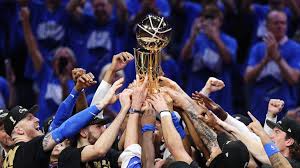
The ultimate physical prize awarded at the conclusion of the grueling two-month postseason journey is the Larry O’Brien Championship Trophy. Designed by Tiffany & Co., this iconic piece of art stands two feet tall, is crafted from 14.5 pounds of sterling silver, and is plated in gleaming 24-karat gold. It depicts a regulation-sized basketball poised elegantly over a stylized hoop and backboard.
Standing right alongside the team trophy is the highly coveted Bill Russell NBA Finals Most Valuable Player Award. Named in honor of the ultimate champion, this individual accolade recognizes the single performer who stepped up with the highest efficiency, statistical dominance, and clutch execution under the bright lights of the championship stage.
4. Tactical Masterclass: The Chess Game of a Seven-Game Series
What makes the NBA Finals a true masterpiece of sports strategy is its best-of-seven format. Unlike a single-elimination tournament where a lucky shot or a bad refereeing call can decide a champion, a seven-game series is a brutal war of attrition and rapid mental adaptations.
+-----------------------------------------------------------------+
|                   THE FINALS ADJUSTMENT MATRIX                  |
+-----------------------------------------------------------------+
|  Game 1-2: Establish Baseline Strategy & Core Offensive Flow    |
|                               │                                 |
|                               ▼                                 |
|  Game 3-4: Film Review --> Target Weak Defenders in Pick-and-Roll|
|                               │                                 |
|                               ▼                                 |
|  Game 5-7: Extreme Lineup Shifts --> Going Small / Defensive Traps|
+-----------------------------------------------------------------+
The Pick-and-Roll Target System
By the time two elite teams reach the NBA Finals, their traditional offensive plays are thoroughly logged, indexed, and analyzed by the opposing coaching staff. The series quickly boils down to hunting specific weaknesses.
Offensive masterminds will repeatedly run pick-and-roll actions to force a defensive “switch,” intentionally isolating the opposition’s weakest perimeter defender or slowest center against an elite, lightning-fast superstar playmaker.
The Crucial Role of Rotation Shortening
During the regular 82-game season, head coaches routinely utilize a deep 10-to-12-player rotation to protect health and preserve energy. In the high-stakes pressure cooker of the NBA Finals, that rotation aggressively shrinks to just 7 or 8 trusted players.
Sub-par defenders and inconsistent shooters are completely benched, forcing the team’s core superstars to routinely play 42 to 45 grueling minutes per match, demanding an elite level of physical conditioning and mental stamina.
5. Statistical Supremacy: The Numbers That Define Finals Royalty
To truly understand which athletes stand at the absolute pinnacle of basketball history, one must look directly at the individual all-time statistical charts recorded exclusively within the high-pressure environment of the NBA Finals.
| Basketball Legend | Total Finals Appearances | Championships Won | Career Finals Points | Key Defining Statistic |
| Bill Russell | 12 | 11 | 1,151 | All-Time Record 11 Championship Rings |
| Sam Jones | 11 | 10 | 1,143 | Crucial clutch shooter for the historic Celtics |
| Kareem Abdul-Jabbar | 10 | 6 | 1,317 | Eldest Finals MVP winner in history (Age 38) |
| LeBron James | 10 | 4 | 1,562 | Only player to average a triple-double in a Finals |
| Jerry West | 9 | 1 | 1,679 | All-Time Finals Scoring Leader (The Logo) |
| Michael Jordan | 6 | 6 | 1,176 | Perfect 6-0 Record with 6 Finals MVP Awards |
6. The Sports Science of Finals Preparation: Building the Elite Gladiator
The physical wear and tear on an athlete by the time they reach the NBA Finals in June is nothing short of catastrophic. Having already survived an arduous 82-game regular season followed by three brutal, high-impact playoff series, the human body is completely pushed to its absolute structural limits.
High-Tech Cryotherapy and Hyperbaric Recovery
To keep million-dollar muscle fibers firing at peak efficiency, franchise medical staffs transform team hotels into advanced sports science clinics. Players routinely utilize:
-
Whole-Body Cryotherapy Chambers: Exposing the body to sub-zero temperatures for three minutes to immediately flush out lactic acid and reduce system-wide inflammation.
-
Soft-Tissue Hyperbaric Chambers: Flooding the player’s lungs with 100% pure oxygen under increased atmospheric pressure, accelerating cellular repair and muscle tissue healing by over 40%.
+---------------------------------------------------------------------+
|                      THE FINALS SPORTS SCIENCE MATRIX               |
+---------------------------------------------------------------------+
|  * Micro-Chip Load Tracking: Monitors real-time structural fatigue  |
|  * Neuro-Catch Light Arrays: Keeps cognitive reflex speeds razor-sharp|
|  * Targeted Macro Nutrition: Custom carbohydrate fuels for longevity |
+---------------------------------------------------------------------+
Neuro-Cognitive Priming Under Fatigue
In the closing minutes of a critical Game 6 or Game 7, physical exhaustion is a given. The team that wins is the one whose minds can cut through the fatigue to make correct split-second analytical choices.
Superstars utilize advanced neuro-tracking light pods during warm-ups to sharpen peripheral vision, ensure spatial awareness remains high, and keep reactive reflex speeds locked down to milliseconds despite intense physical exhaustion.
7. The Business Blueprint: The Financial Machine of the Finals
The NBA Finals represent the absolute commercial goldmine of the league’s financial calendar. Every single minute of broadcasting, every ticket sold, and every corporate logo displayed inside the arena is carefully optimized to generate massive global revenue.
Global Media Rights and Advertisement Surges
Broadcasting networks pay massive multi-billion-dollar premiums to secure the rights to air the series. Because live sports entertainment is one of the few remaining products that audiences refuse to watch on tape delay, prime-time commercial slots during a tight fourth quarter can command over $800,000 for a brief 30-second window.
The globalization of the broadcast—streaming live to over 200 countries in more than 50 languages—allows local brands to gain unprecedented international exposure.
Host City Tourism and the Secondary Ticket Market
The economic impact of a home game during the NBA Finals on a host city’s local economy is immense. Hotels, restaurants, transport networks, and sports bars experience a massive influx of tourist revenue.
Simultaneously, the secondary ticket market reaches astronomical heights; courtside seats next to Hollywood celebrities routinely trade hands for upwards of $50,000 per ticket, making the series one of the most exclusive, high-net-worth live entertainment gatherings on the planet.
📌 The Ultimate Finals Clutchness Box
Did you know that Michael Jordan’s iconic “Flu Game” during Game 5 of the 1997 NBA Finals was actually revealed to be a severe case of food poisoning? Despite suffering from extreme dehydration, tremors, and exhaustion, Jordan played 44 minutes, scoring 38 points to carry the Chicago Bulls to a vital, legendary victory!
8. Unforgettable Iconic Moments: The Folklore of the Canvas
The ultimate history of the NBA Finals is written in unforgettable, heart-stopping individual moments that are replayed by sports fans for generations. These singular plays define legacies and cement names into basketball eternity.
The Block (LeBron James – 2016)
With less than two minutes remaining in an intense Game 7 of the 2016 series, the Cleveland Cavaliers and Golden State Warriors were deadlocked. As Andre Iguodala went up for what appeared to be an easy, breakaway layup, LeBron James sprinted the entire length of the court, tracking the ball with predatory precision, and pinned it cleanly against the glass. It remains the most physically jaw-dropping defensive recovery in the history of the sport, leading to Cleveland breaking their historic championship drought.
The Last Shot (Michael Jordan – 1998)
The perfect, poetic conclusion to an empire. Trailing by one point against the Utah Jazz in Game 6 of the 1998 series, Michael Jordan stripped the ball from Karl Malone, drove down the court, executed a subtle crossover that sent Bryon Russell sliding across the hardwood, and elevated for a pristine, mid-range jumper. As the ball rattled through the net to secure his sixth and final championship, Jordan created the single most iconic visual image in the history of global sports.
The Savior Three-Pointer (Ray Allen – 2013)
With the yellow security tape already being rolled out around the court to prepare for the San Antonio Spurs’ championship celebration in Game 6, the Miami Heat looked completely buried. Missed shot, offensive rebound by Chris Bosh, a blind pass back to the corner, and Ray Allen stepped backward without looking, rising into the air with seamless, mechanical perfection. The ball tore through the net with five seconds left to force overtime, saving the Heat’s season and allowing them to capture Game 7.